Weekend Warrior Physical Activity, Sedentary Behavior, and Incident Disability in Middle-Aged and Older Adults: A UK Biobank Accelerometer Study
发布时间:2026-10-19浏览量:一、报告摘要
Aim: Regular moderate-to-vigorous physical activity (MVPA) is associated with lower risks of functional decline and disability. Whether concentrating MVPA into 1 or 2 days per week—the “weekend warrior” pattern—is associated with disability risk similarly to regularly distributed activity remains unclear, particularly among individuals with high sedentary behavior.
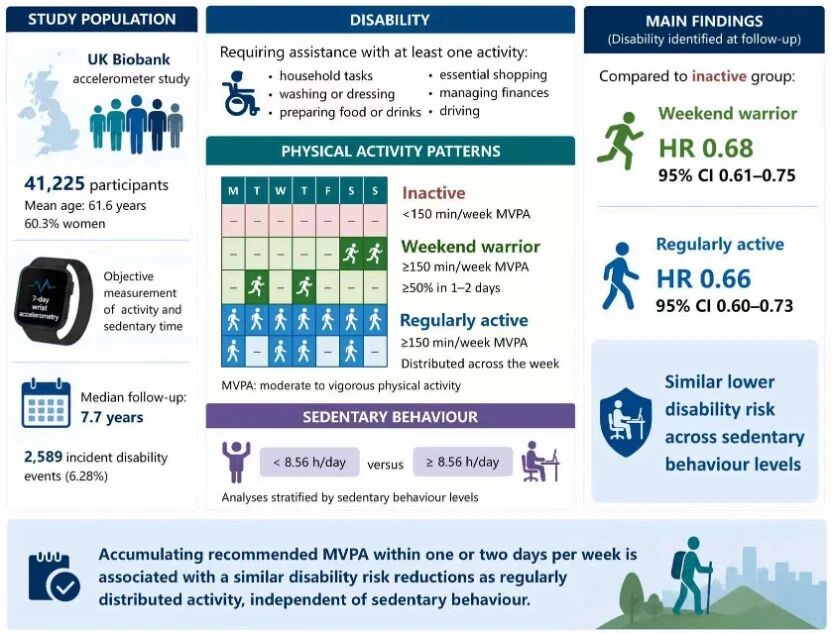
Methods: We analyzed wrist-worn accelerometer data from 41 225 UK Biobank participants without identifiable baseline disability based on available indicators (mean age 61.6 years; 60.3% women). Participants were classified as inactive (< 150 min/week), weekend warriors (≥ 150 min/week with ≥ 50% accumulated in 1–2 days), or regularly active (≥ 150 min/week but not weekend warriors). Disability was assessed once during follow-up and defined as a self-reported need for assistance with at least one of six activities of daily living because of a health condition. Associations with incident disability were estimated using Cox proportional hazards models for interval-censored outcomes, adjusting for sociodemographic characteristics, lifestyle factors, and baseline health status.
Results: During a median follow-up of 7.7 years, 2589 participants were classified as having disability at follow-up. Compared with inactive individuals, weekend warrior and regularly active patterns were associated with similarly lower disability risk (weekend warrior: HR 0.68, 95% CI 0.61–0.75; regularly active: HR 0.66, 95% CI 0.60–0.73). These associations were observed across sedentary behavior levels.
Conclusions: Accumulating recommended MVPA within 1 or 2 days per week was associated with disability risk reductions comparable to regularly distributed activity. Flexible activity patterns may help support functional independence and healthy aging.
二、论文发表截图
三、作者介绍

朱璇
朱璇,中国人民大学统计学院2026级博士研究生。研究方向包括老年失能风险管理、样本选择偏倚校正、多源人口健康数据融合。

夏贺彦
夏贺彦,2026年博士毕业于中国人民大学统计学院,现为首都经济贸易大学统计与数据科学学院讲师,主要研究方向包括多状态生存模型、可穿戴数据、老年健康风险管理等。研究成果发表于《统计研究》、Geriatrics & Gerontology International、《保险研究》等期刊。曾获国际统计会议ICSA 2024 Poster奖项。

孙韬
孙韬,中国人民大学统计学院副教授,博士毕业于美国匹兹堡大学生物统计系。主要研究方向为复杂生存数据建模、健康老龄化统计方法、老年失能失智风险管理以及人工智能驱动的疾病风险预测。研究成果发表于Biometrics, Demography, Age and Ageing等统计学、人口学和老年学期刊。主持国家自然科学基金青年项目和面上项目。

王晓军
王晓军,中国人民大学吴玉章讲席教授,统计学院教授。国家统计专家咨询委员会委员,兼任中国统计教育学会副会长、全国应用统计专业学位研究生教育指导委员会秘书长。主要从事人口统计、人寿保险、养老金、社会保障以及与健康相关的风险量化模型与应用研究。
更多文章
- Weekend Warrior Physical Activity, Sedentary Behavior, and Incident Disability in Middle-Aged and Older Adults: A UK Biobank Accelerometer Study
- Sequential three-dimensional ultrasound diagnosis of a T-shaped uterus
- Decomposing Differences in Cohort Health Expectancy by Cause and Age with Longitudinal Data
- Reduced Rank Multivariate Spatial Autoregressive Model for Large-scale Networks